The Indian government’s directive ordering IndiGo to trim its winter schedule by 5%—amounting to roughly 115 flights a day—marks the most forceful intervention in the airline industry since the post-pandemic period. The move follows IndiGo’s operational turbulence earlier in December 2025, when mass cancellations stranded passengers across the country and raised questions about airline preparedness, regulatory oversight, and system-wide resilience.
A Crisis Years in the Making
IndiGo, which controls more than 60% of India’s domestic aviation market, entered the winter season on the back foot. Its troubles intensified after new Flight Duty Time Limitation (FDTL) rules came into force on November 1, 2025. These norms—designed to reduce pilot fatigue—mandate longer rest periods, tighter night-duty limits, and expanded definitions of night operations.
While the Directorate General of Civil Aviation (DGCA) announced these changes nearly two years earlier, IndiGo reportedly failed to scale its pilot workforce to match the stricter requirements. The mismatch proved costly: between December 1 and 8 alone, the airline cancelled more than 2,700 flights, pushing on-time performance to an unprecedented low of 30%.
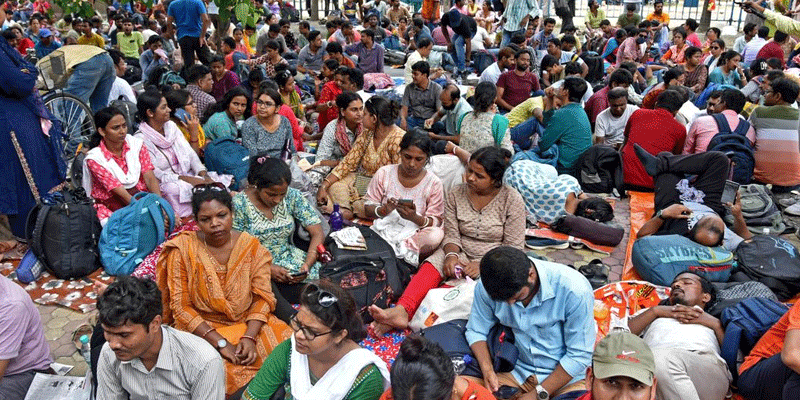
The passenger fallout was immense. IndiGo processed around Rs 745 crore in refunds for over 730,000 cancelled bookings, with additional reimbursements amounting to Rs 610–827 crore. Nearly six lakh travelers were affected, with baggage mishandling and itinerary reshuffles fuelling public frustration.
The chaos compelled the aviation ministry to intervene, both as a regulatory check on a dominant airline and as a measure to restore sectoral confidence.
Government Pushback and Sectoral Implications
Civil Aviation Minister K. Ram Mohan Naidu signaled “exemplary action” for any lapse in safety compliance while announcing the 5% capacity cut and reallocation of slots to rival carriers. The decision underscores a policy shift: IndiGo’s scale is no longer viewed as a stabilizing force but as a potential point of systemic vulnerability when mismanaged.
This recalibration also reflects the broader reality that India’s aviation expansion—one of the fastest globally—has outpaced infrastructure, manpower, and operational buffers. IndiGo’s crisis exposed these cracks, suggesting that unchecked growth without redundancy risks nationwide disruption.
Impact on Regional Connectivity: Short-Term Pain, Long-Term Realignment
The mandated reduction threatens to hit regional India hardest. IndiGo currently holds monopoly or near-monopoly control on a majority of tier-2 and tier-3 routes. Cities such as Imphal, Jaipur, Jaisalmer, Durgapur, and Varanasi depend heavily on IndiGo for direct links that support tourism, trade, and mobility.
Short-Term Disruptions
· Reduced Frequencies: IndiGo is likely to preserve high-yield metro routes first, cutting flights to smaller cities.
· Higher Fares: With fewer seats available, ticket prices may rise 20–30%, especially on non-UDAN sectors.
· Longer Travel Times: Passengers may increasingly rely on connecting flights, adding delays and uncertainty.
These effects mirror the chaos already experienced during the cancellation wave, where regional airports faced disproportionately severe disruptions.
Potential Long-Term Upsides
Slot redistribution to carriers such as Air India Express and Akasa has the potential to decentralize market power and improve service diversity. However, rival airlines still face fleet and crew limitations that may slow the pace of recovery. Over time, a more balanced market structure could enhance competition and reduce vulnerability to single-airline shocks.
Economic Ripples
Reduced connectivity could dampen tourism, suppress business travel, and temporarily slow economic activity in smaller cities. Air travel often acts as an economic multiplier in emerging regions; thus, any contraction in capacity risks stalling growth. Nevertheless, improved competition—if realized—may yield more resilient, demand-responsive networks in the long run.
A Corrective Shock with Systemic Consequences
The Centre’s directive to cut IndiGo’s flights represents not merely a regulatory reprimand but a structural correction. While the immediate fallout will inconvenience passengers—especially outside metro hubs—the intervention may push India’s aviation sector toward healthier competition and more sustainable expansion. The challenge now is ensuring that short-term pain translates into long-term stability, preventing any single carrier’s missteps from crippling the nation’s air transport ecosystem again.
(With agency inputs)